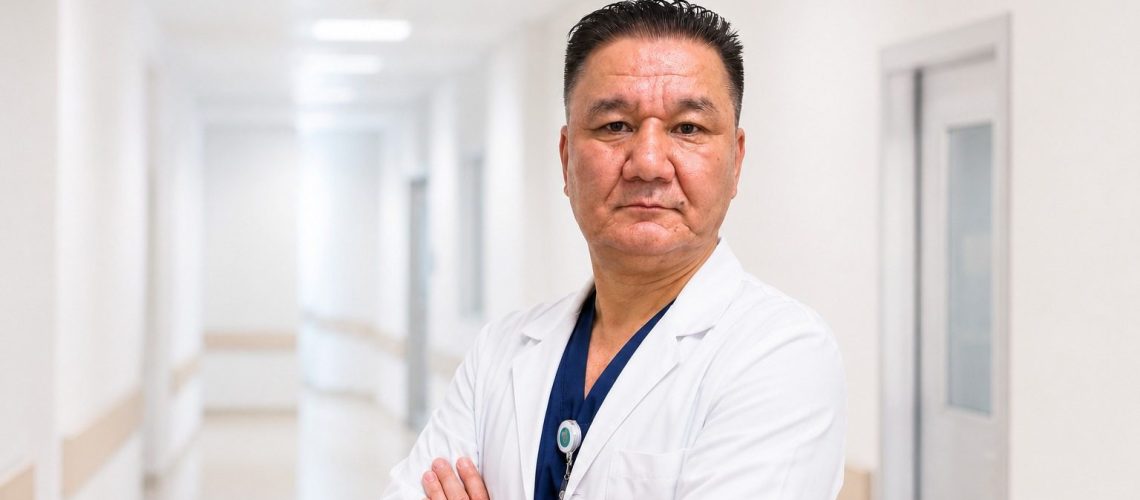
This year marks the 38th anniversary of Yeltay Shildebayev’s career in medicine. After graduating from Saratov State Medical University in Russia in 1994, he has never spent a single day away from his profession. Since 2008, he has been working at the National Hospital.
What influenced your decision to specialize in urology? And what issues in this field concern you most today?
Even during my fourth year at university, I became deeply interested in urology. My professors Raikevich, Popkov, and Glybochko had a tremendous influence on my choice. They were renowned and highly educated specialists in Russia.
As for today’s challenges in urology, I am concerned about the significant increase in the number of patients. Many of them suffer from chronic diseases that seriously reduce their quality of life. Patients sometimes joke, “Visiting a urologist once is harder than going to the dentist ten times.”
Today, urological surgery is highly advanced, and new technologies are being actively introduced. At our hospital, we make extensive use of modern treatment methods. However, technologies in Europe and the United States are constantly evolving. I would like to see the most advanced, albeit very expensive, technologies become available in our country as well. It would be beneficial if the government allocated more funding for this purpose.
What conditions do patients most commonly seek treatment for?
The most common conditions include kidney stones, various prostate diseases, and inflammatory diseases of the kidneys and bladder. Many patients also suffer from infertility and sexual dysfunction. This is a very worrying trend. In addition, young people today often do not pay sufficient attention to their health.
If it is not a secret, could you tell us a little about your family? It is said that your daughter Dana is very talented. Could you share some of her achievements?
There is a saying among our people: “A home with elders is rich in blessings.” My mother is 85 years old and lives with me. She raised eight children and has 27 grandchildren and 32 great-grandchildren. My wife, Saltanat, teaches English at a university. I am the father of three children.
My eldest son, Nurymzhan, decided to follow in my footsteps and become a doctor. He is currently studying at a medical university. My eldest daughter, Dana, graduated from high school this year and plans to enter university.
In 2025, Dana received a gold medal at a major international science olympiad in South Korea. She developed a device capable of extracting drinking water from the air. A memorandum was signed with the ministry to implement the project on an industrial scale, and the development received funding.
This year, Dana won third place at a world olympiad held at the headquarters of the United Nations in Austria. There, she met with presidents of African countries and discussed ways to provide water to arid regions. A child’s success is a great joy for parents. I have high hopes for my daughter’s future.
Today, people often say that parents are too busy to devote enough time to raising their children. What are your thoughts on this?
It is difficult to disagree with that. We do devote a great deal of time to our work. However, my children are fortunate to have two wonderful grandmothers—my mother and my wife’s mother. They do their best to spend as much time as possible with their grandchildren, and I am very grateful to them for that.
At the same time, this does not mean that we shift our responsibilities onto the older generation. Whenever we have free time, my wife and I make every effort to communicate with our children and spend quality time together.
Our own parents were also busy with work. We grew up alongside our grandparents, learning from their life experience, wisdom, and values. I believe that children who grow up close to their elders and listen to their advice receive an invaluable upbringing.
The Kazakh people have never forgotten the words “shukur” and “taube.” Today, many say that gratitude is becoming increasingly rare. What is your opinion?
You are absolutely right. These words were instilled in us from childhood through our mothers’ care, our fathers’ upbringing, our grandfathers’ wisdom, and our grandmothers’ love. Essentially, they teach us to be grateful and content with what we have.
Of course, everyone should strive for success and personal growth. However, one should never lose a sense of gratitude and moderation. Such people tend to sleep more peacefully, enjoy better health, and often live longer. In the past, our mothers would say these words every day. Unfortunately, this is becoming less common today.
What concerns you most as a citizen of Kazakhstan?
What concerns me most is the peace and stability of our country. Around us, there are more and more nations where wars are taking place and people are suffering. Our ancestors also endured many hardships.
Fortunately, today we are an independent state recognized throughout the world. It is therefore especially important for us to preserve our unity, solidarity, and mutual understanding.
Taking this opportunity, I would like to congratulate the staff of the National Hospital and all my colleagues on their professional holiday. I wish everyone good health, prosperity, and recognition from their patients.