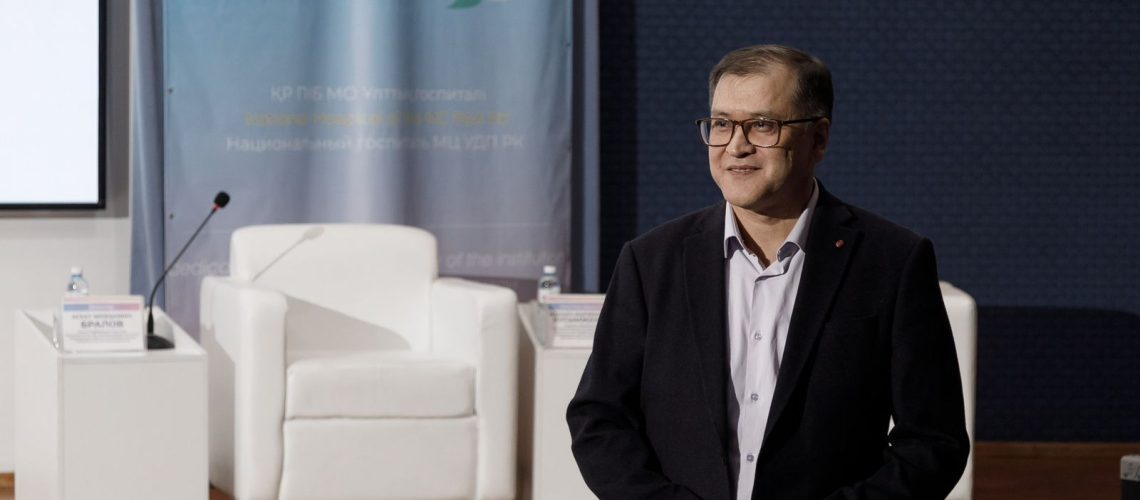
On December 11-12, 2025, Almaty hosted the II International Congress of Young Scientists of Kazakhstan, organized by the National Academy of Sciences under the President of the Republic of Kazakhstan and dedicated to the UNESCO theme: “Trust, transformation and tomorrow: the science we need by 2050.” The event was attended by representatives of 26 countries, including foreign experts and Kazakh scientists working in Hong Kong, England, France and Japan.
The first day was attended by Advisor on Science, Education and QS of the National Hospital of the MC UDP of the Republic of Kazakhstan Kusymzhanova Zhanara, head of the Center for Innovation and Education of the National Hospital Isaeva Asia, as well as Chairman of the Council of Young Specialists Maratova Moldir, who took part in the foresight session dedicated to the strategic directions of science development.
The keynote address was made by the President of the National Academy of Sciences of the Republic of Kazakhstan, academician Asylbek Kurishbayev, who presented an expert model for the development of science, new interdisciplinary initiatives and the results of foresight research. Foreign and domestic scientists discussed the role of youth in global transformations, the need for interdisciplinary research, the development of international research consortia and the introduction of artificial intelligence in scientific processes.
The second day was devoted to the work of thematic sections. The section on health and life sciences was held at KazNMU named after S.D. Asfendiyarov, where Isaeva Asiya made a presentation.
The theme of her speech:
“Exploring the Impact of Health Accreditation on Improving Quality and Outcomes: A Little Bit About Leadership and Organizational Behavior.”
In her report, she noted that accreditation is not only a tool for improving quality, but also an incentive for deep organizational change. In this context, effective leadership that fosters mature organizational behavior that promotes employee self-motivation, accountability, and sustainable standards is of particular importance. All this directly affects the successful completion of accreditation and improving the quality of work of medical institutions.